
Building Back Better in Mandalay: Lessons in Resilience, Recovery, and Community Leadership

By: Dr. Tobias Endress
The AIT School of Management welcomed Dr. Naing Win Htet, President of the Rotary Club of Mandalay, healthcare entrepreneur, and community leader, for a guest speaker session titled “Building Back Better in Mandalay: Resilience, Recovery, and Community Leadership After the Earthquake.” The session took place on 19 May 2026 at the AIT Downtown Campus in Bangkok and was facilitated by Dr. Tobias Endress.


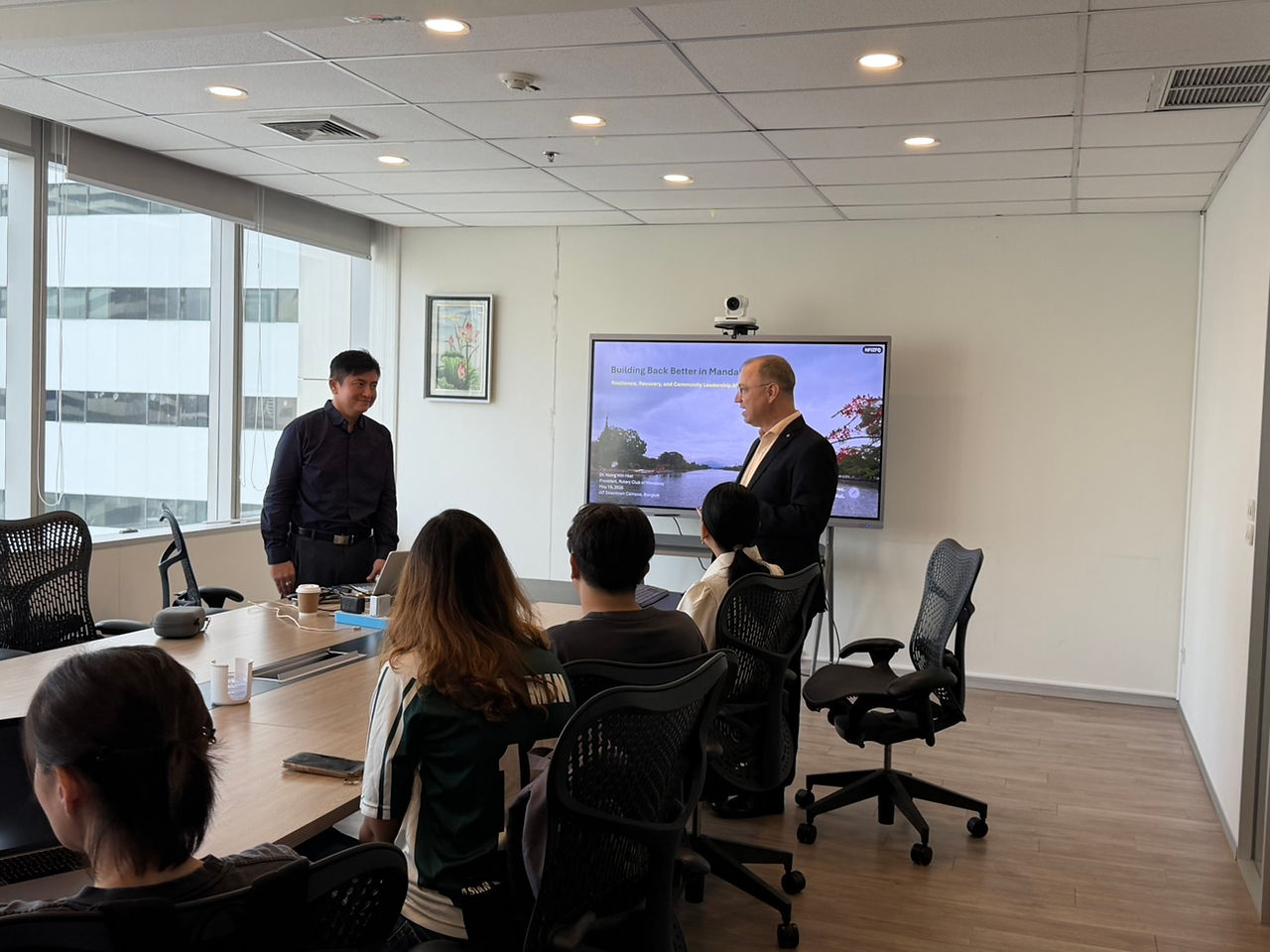

The talk was part of SOM’s “Building Back Better” series, which explores how communities, institutions, businesses, and civic organizations respond to major crises and contribute to long-term recovery. Following the first session on Ukraine’s reconstruction and resilience, this second session focused on Mandalay and the lessons emerging from the devastating earthquake that struck Myanmar on 28 March 2025.
Dr. Htet began by introducing Mandalay not only as Myanmar’s second-largest city, but also as a cultural, religious, and economic center. He emphasized that Mandalay is deeply connected to Myanmar’s national identity through its royal history, monasteries, markets, food culture, and role as a transport and trade hub for Upper Myanmar. Therefore, when Mandalay was hit by the earthquake, the impact was not only local but deeply felt across the country.
The earthquake caused severe damage to homes, hospitals, schools, roads, bridges, religious buildings, and local businesses. Dr. Htet explained that the disaster struck a city already under pressure from several years of accumulated challenges, including the effects of COVID-19, political instability, conflict, economic disruption, and weakened public services. This made the earthquake not only a natural disaster, but also a social, economic, and humanitarian crisis.
A central message of the session was that Mandalay’s recovery cannot be understood only through collapsed buildings and damaged infrastructure. It must also be understood through the role of social capital. Dr. Htet highlighted how neighbours, ward-level groups, monasteries, rescue volunteers, funeral-service organizations, businesses, healthcare providers, and service clubs responded immediately—often before formal or international assistance arrived.
Community kitchens, water distribution, temporary shelters, rescue efforts, medical support, and local donation networks became essential parts of the emergency response.
The discussion showed that Mandalay’s “invisible infrastructure”—trust, relationships, local knowledge, and community service networks—played a crucial role in the first days after the earthquake. Many people helped others even while their own homes, shops, or families were affected. This spirit of mutual aid demonstrated that resilience is not only about physical reconstruction, but also about people’s willingness and ability to support one another under pressure.
Dr. Htet also reflected on the importance of learning from cascading risks. The earthquake was followed by aftershocks, fires, shelter challenges, health risks, communication disruptions, and economic shocks. For this reason, “building back better” must include more than rebuilding damaged structures. It requires safer construction, stronger local disaster committees, better fire-risk planning, resilient healthcare systems, support for small businesses, improved data coordination, and stronger cooperation among local, national, and international partners.
The session provided students with a practical and human-centered perspective on crisis management, community resilience, and recovery leadership. It showed how healthcare professionals, entrepreneurs, civic leaders, local businesses, volunteers, and service organizations can all contribute to rebuilding after a crisis.
Opportunities Emerging from Recovery
While the earthquake caused deep human, social, and economic losses, Dr. Htet also emphasized that recovery can create important opportunities for long-term improvement. In Mandalay, the rebuilding process has opened space for safer construction practices, stronger disaster preparedness, and more resilient local systems. There is now greater awareness of the need for building-code enforcement, structural assessments, retrofitting, emergency planning,
and fire-risk management.
The recovery process also creates opportunities for local businesses and entrepreneurs. Demand has increased for construction services, engineering expertise, healthcare support, logistics, food supply, retail essentials, water distribution, and household repair services. Supporting local SMEs in these areas can help restore livelihoods while also strengthening the city’s recovery capacity.
Another important opportunity lies in strengthening cooperation between community organizations, service clubs, universities, healthcare providers, local businesses, donors, and international partners. Dr. Htet’s presentation showed that Rotary and similar service networks can play a bridging role by connecting local trust with wider resources, accountability, and cross-border support. For students and future leaders, this highlights how crisis recovery can also become a platform for responsible leadership, social innovation, and inclusive development.
Ultimately, the idea of “building back better” means using recovery not only to repair damage, but also to reduce future vulnerability. Mandalay’s experience shows that reconstruction can be an opportunity to build safer infrastructure, stronger communities, better-prepared institutions, and a more resilient local economy.
AIT School of Management sincerely thanks Dr. Naing Win Htet for sharing his experiences and insights from Mandalay, and for reminding us that building back better is not only about restoring what was lost. It is about reducing future vulnerability, strengthening communities, and creating systems that are more prepared, inclusive, and resilient.


